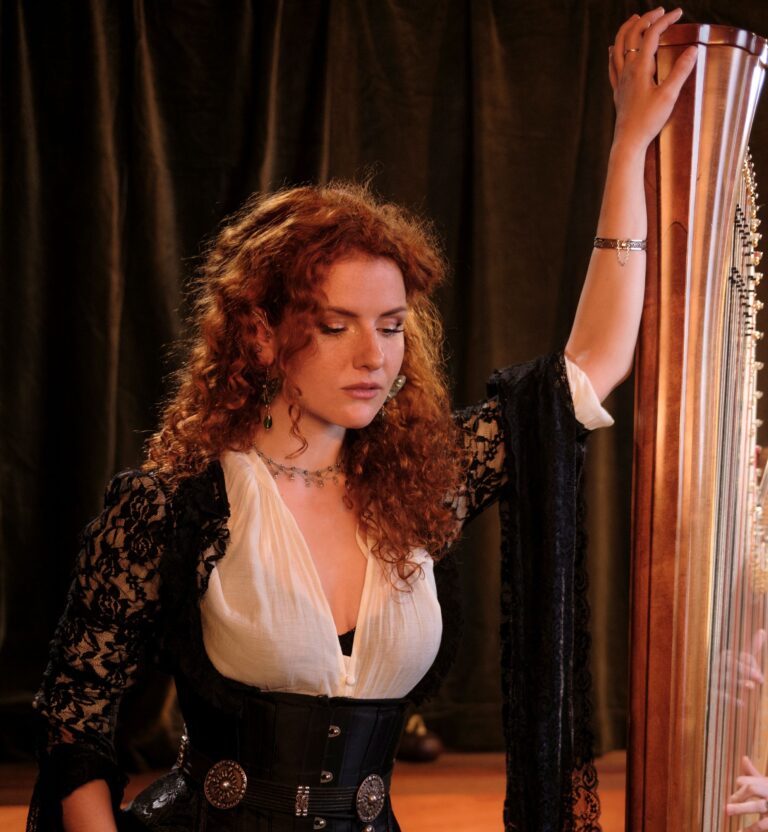



For the first time on the Bulgarian stage, on May 14 at the "Opera" hall in Ruse, the prima donna Tsvetelina Vasileva will embody one of the most inspiring and multi-layered female characters in opera literature – that of Tatiana from Tchaikovsky's "Eugene Onegin." In this character meet the purity of youth, the power of dreams, and the inevitable painful coming of age — that inner journey from romantic sensitivity to mature, conscious choice. It is precisely on this depth and psychological evolution that the conversation with Tsvetelina Vasileva is built, where in her interpretation of Tatiana she reveals the different layers of the heroine — from the tender and dreamy girl to the woman who goes through disappointment, inner transformation, and spiritual growth. She shared her thoughts on the power of feelings, the clash between illusion and reality, as well as the inexhaustible psychological depth of Tchaikovsky's music.
In the role of Tatiana, youth, dreams, and a very painful growing up meet. After all your incarnations in this character over the years, what is the hardest to preserve in it – the purity of the feeling or the strength to give it up?
In the character of Tatiana, purity, tenderness, and dreaminess are especially vividly expressed in Tchaikovsky's music. It is with these qualities that she captivates all the other characters in the work. But with the coming of love come the disappointments of rejection. After a heavy inner struggle and suffering, her spiritual growth and a new reassessment of life occur. Tatiana goes through pain and suffering, and gradually turns into a mature, decisive woman, ready to change her life. For me, the moment when Onegin rejects her love is a turning point in her life. This is the moment in which she parts with her childhood. The pain from this experience changes her forever, and she discovers her femininity — something new, inexplicable, and profound for herself. This separation is also a separation from dreams and illusions, because it is one thing to live in the world of mirages, and quite another — in reality. On the other hand, it is precisely the dreams and illusions that give us hope, inspiration, and a sense of beauty.
Tchaikovsky calls 'Eugene Onegin' 'lyrical scenes' and places the deep psychology of the characters at the center. Where, in your opinion, is Tatiana's greatest strength – in her vulnerability, in her dreaminess, or in her ability to make a painful but worthy choice?
Tatiana is one of the most complex and inspiring female characters in opera literature. In my opinion, she is a heroine who shows us that human happiness is inevitably connected with compromises. Without them, it would be difficult for a person to find true harmony in life. Tchaikovsky's music magnificently reveals the psychological portraits of all the characters. In the opening scenes of the opera, Tatiana is a young, gentle, and dreamy girl, filled with longing and hope to encounter true love. Unfortunately, her pure and spontaneous feelings confront a deeply dramatic disappointment.
This marks a sort of break with her carefree girlhood, and her subsequent choice is the result of a brave and conscious spiritual maturation. After this inner transformation, Tatyana enters a new stage of her life. Her decision to be with a worthy and noble person, in my opinion, is correct and mature. In the work, he is often portrayed as older, but in fact, he is a person of dignity, stability, and morality. I believe that together they build a beautiful and harmonious life based on respect, affection, and love.
To what extent does the environment in which Tatyana lives shape her inner world and the way she perceives love?
I would like to point out that the Russian aristocracy at that time lived in a completely different way. These people did not know physical labor — others took care of their daily lives and needs. And when a person is deprived of the necessity to work, especially when living in the countryside, they often fall into a peculiar state of boredom and inner emptiness. Then they begin to live more in the world of thoughts, fantasies, and dreams. It is no coincidence that young girls of that time were strongly influenced by French romantic novels, which they read with great interest. They built their inner world through literature and often perceived love and life in an idealized, almost unreal way. It is in such a world that Tatiana lives — a world of imagination, feelings, and romantic notions. Her character is extremely multi-layered and captivating. Tatiana comes from the Russian nobility, but at the same time carries within her the spirit of folk tradition. She is a peculiar composite image of young Russian girls from the provinces — raised in nature, brought up by governesses and women from the people, who leave a deep imprint on their sensitivity and worldview. That is precisely why there is such purity, sincerity, and closeness to folk psychology in Tatiana. The contrast between this inner sensitivity and the reality of life around her is also very interesting. For example, in the scene where the girls pick strawberries and sing, at first glance, there is a feeling of lightness, joy, and pleasure in the work. The audience perceives this picture as something beautiful and carefree. But in fact, the song has a very practical purpose — the girls sing because they are not allowed to eat the strawberries while picking them, in order to gather the necessary amount of fruit. It is precisely in these small details that the depth and complexity of the world created in the work are revealed.
You have sung on stages like the Metropolitan Opera and the Royal Opera House, in front of audiences all over the world. Is there something particularly different and more personal about performing for the Bulgarian audience when you play Tatiana?
First of all, I want to note that this will be my first performance of the role of Tatiana in Bulgaria. As for audiences abroad, they are not so different from the Bulgarian audience – people everywhere react spontaneously when they are truly moved. They feel the emotion, the sincere presence on stage, the organic acting, and the beautiful singing. This applies to all major opera stages. I have six performances of the role of Tatiana, with perhaps the most vivid memory for me being my participation at Houston Grand Opera, in the famous production by the great German opera director Willy Decker. Later, this production was also presented at La Scala and was distinguished by extremely interesting directorial decisions. Of course, I cannot fail to remember my debut in the role years ago under the baton of Maestro Guadagno in Palm Beach, USA.
After so many years of a worldwide career and various directorial interpretations, does your Tatiana change over time? Is there a moment in the opera that still manages to move you today as if you were experiencing it for the first time?
I always get excited when I talk about Tatiana. This role is inexhaustible – in each subsequent performance, she reveals something new and different. Every stage experience is unique because it is influenced both by the director's concept and the conductor's interpretation of the music, as well as by the interaction with the partners on stage. For example, in the famous production by Willy Decker, first staged at Houston Grand Opera and later at La Scala, I was placed in such unexpected situations that I began to experience the feelings of the other characters as well. Tatiana is present in every scene – she observes, senses, and experiences everything that happens around her. This is an extremely rich and multilayered character that gives you the opportunity to discover new nuances each time and to experience the role as if for the first time.
I hope that here too, on the stage in Ruse, I will discover new and exciting moments with Tatyana. I am convinced that with Maestro Palikarov we will create a beautiful and emotional performance.
Ultimately, what do you think makes Tatiana such a contemporary and exciting character even today?
I think Tatiana remains so close to people even today because she carries some of the most beautiful human virtues – loyalty, integrity, the ability to love and take care of those around her. The true beauty of a woman is in being dignified, faithful to her feelings, her family, and her moral values. There is no happiness built on lies, deceit, or betrayal. And love, ultimately, is at the foundation of everything. Everything beautiful in the world is born precisely from it.